
Deep cut
Tuesday, November 3, 2026
The ox-cart railway on Crum Creek - Thomas Leiper's 1810 track
If you grew up in Wallingford or Nether Providence, you went to Strath Haven or you played against them. Most people never ask where the name comes from.
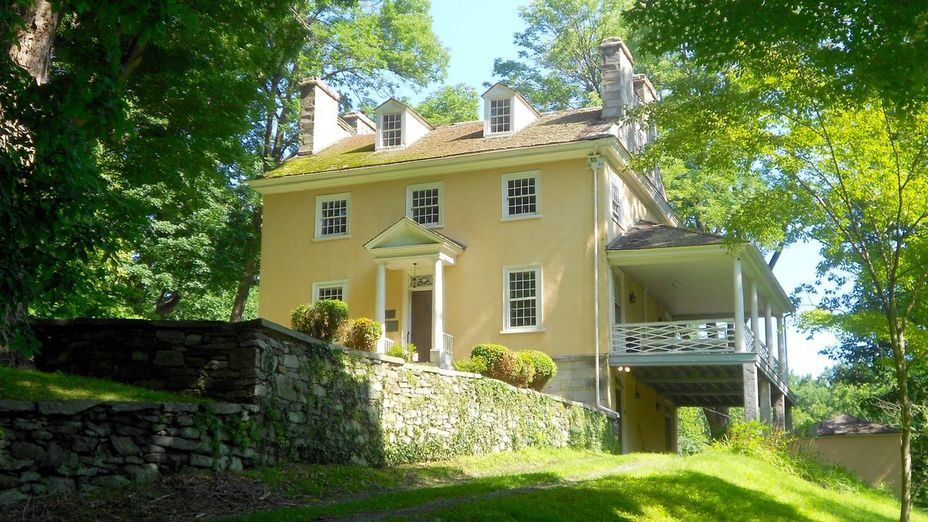
If you grew up in Wallingford or Nether Providence, you went to Strath Haven or you played against them. Most people never ask where the name comes from. It comes from a yellow stucco house on Avondale Road, and from a Scottish tobacco man who, about 215 years ago, built a railway on Crum Creek before most Americans had ever seen one.
I like this one because you can still go stand where it happened. There's a state marker on Bullens Lane, and the house is open on weekend afternoons through December.
The quarry problem
Thomas Leiper was born in Strathaven, Scotland, in 1745 and came to Philadelphia in the 1760s, where he made his money in tobacco. His Wikipedia biography says he was a founder of the Philadelphia City Troop and rode with it during the Revolution, and that he rented a Philadelphia house to Thomas Jefferson, who became a close friend.
What matters for Delco is the land he bought along Crum Creek in what's now Nether Providence Township. Leiper had mills there and stone quarries, and his granite was good. The trouble was getting heavy stone from the quarry to a boat. Crum Creek wasn't navigable, and the roads of the day couldn't handle loaded wagons in every season. According to his biography, Leiper and a neighbor asked the Pennsylvania legislature in 1790 for permission to dig a canal, and the answer was no.
The test in Philadelphia
So Leiper tried something new. In 1809 he had a short test track built in Philadelphia. The historian John Bach McMaster, quoted in the Leiper Railroad's Wikipedia entry, puts it in the yard of the Bull's Head Tavern and describes it as about 60 feet long, laid on a grade of an inch and a half to the yard. Wikipedia's Leiper biography gives the track as 180 feet and places it in Northern Liberties, so the details depend on who's telling it. Both agree on the punchline. One horse pulled a four-wheeled wagon loaded with about 10,000 pounds up that slope while people watched.
That was enough proof for Leiper. Before the fall of 1809, McMaster writes, workers were already building the real thing out on his land.
The railway on Crum Creek
The Pennsylvania Historical and Museum Commission marker at Bullens Lane and Glen Road in Nether Providence tells it in a few lines. The railway was built in 1809 and 1810 by Thomas Leiper and surveyed by John Thomson. It carried stone from the quarries on Crum Creek to the landing on Ridley Creek, a distance of three quarters of a mile, and it crossed the road right where the marker stands.
From there, Wikipedia's Leiper biography fills in the picture. An ox walked between the rails, pulling a cart of stone from the quarry down to tidewater on Ridley Creek, where it was loaded onto boats bound for Philadelphia and points along the coast. The cars rolled on metal wheels, and when the wooden rails wore out, they were replaced with stone. The Leiper Railroad entry says it ran regularly from 1810 until 1828.
Was it really the first?
The state marker makes two claims. It calls the Leiper line "the first railway in Pennsylvania" and "the first in America to be surveyed." The Wikipedia entries for Leiper and his railroad back up the Pennsylvania part, and McMaster gave Leiper credit for "the first permanent tramway in America."
The bigger "first in America" title is where you'll get an argument. Wikipedia's Leiper biography points to earlier, more temporary tramways, including a gravity line British soldiers built at the Niagara portage in Lewiston, New York, in 1764 and a short track on Boston's Beacon Hill in 1795. Massachusetts fans will tell you about the Granite Railway in Quincy, another quarry line. So I'd put it this way at a party. Leiper's track on Crum Creek was Pennsylvania's first railway, and it has a real claim on being the first permanent one in the country.
Canal, then rails again
Here's the twist I love. The Leiper Railroad entry says that when Leiper's petition for a canal finally went through in the 1820s, the canal replaced the railway, right as the rest of the world was starting to bet on rails. The rails came back anyway. Wikipedia says the canal was later replaced in turn by a railroad spur around 1850, and the two Leiper entries don't agree on exactly when or whose. Thomas Leiper himself died in 1825, so he never saw the canal he'd waited decades for.
The house he left behind
Leiper's money built an estate in Nether Providence. The Nether Providence historical society says the house went up around 1785 and was first named Strath Haven, after his birthplace, and that the Leiper family brought the Strath Haven name to the area that year. That's where your school name comes from. The property today includes the three-story yellow stucco mansion, a smokehouse and a stone vault that the society says is considered the first private bank in America. That's their claim, so take it as local pride with a footnote.
The house almost didn't make it. In 1963, the society says, the estate was in the way of the proposed Mid-County Expressway, the Blue Route, and a group of residents formed Historic Delaware County, Inc. to fight it. They pushed Nether Providence Township to buy the mansion, and in December 1973 the owner agreed to sell the parcel to the township.
Go see it
The Friends of the Leiper House run guided tours on Saturdays and Sundays from 1 to 4, April through December, weather permitting. The house is at 521 Avondale Road in Wallingford. The society warns that the grounds are hilly and you get into the house by way of historic stone steps, so wear good shoes. Full-time caretakers live there, so please don't wander the grounds when it's closed.
Then drive over to Bullens Lane and Glen Road and find the blue-and-gold marker. Stand there a minute. More than two hundred years ago, an ox hauled a cart of Delco granite across that spot on wooden rails, because the state wouldn't give Thomas Leiper his canal.